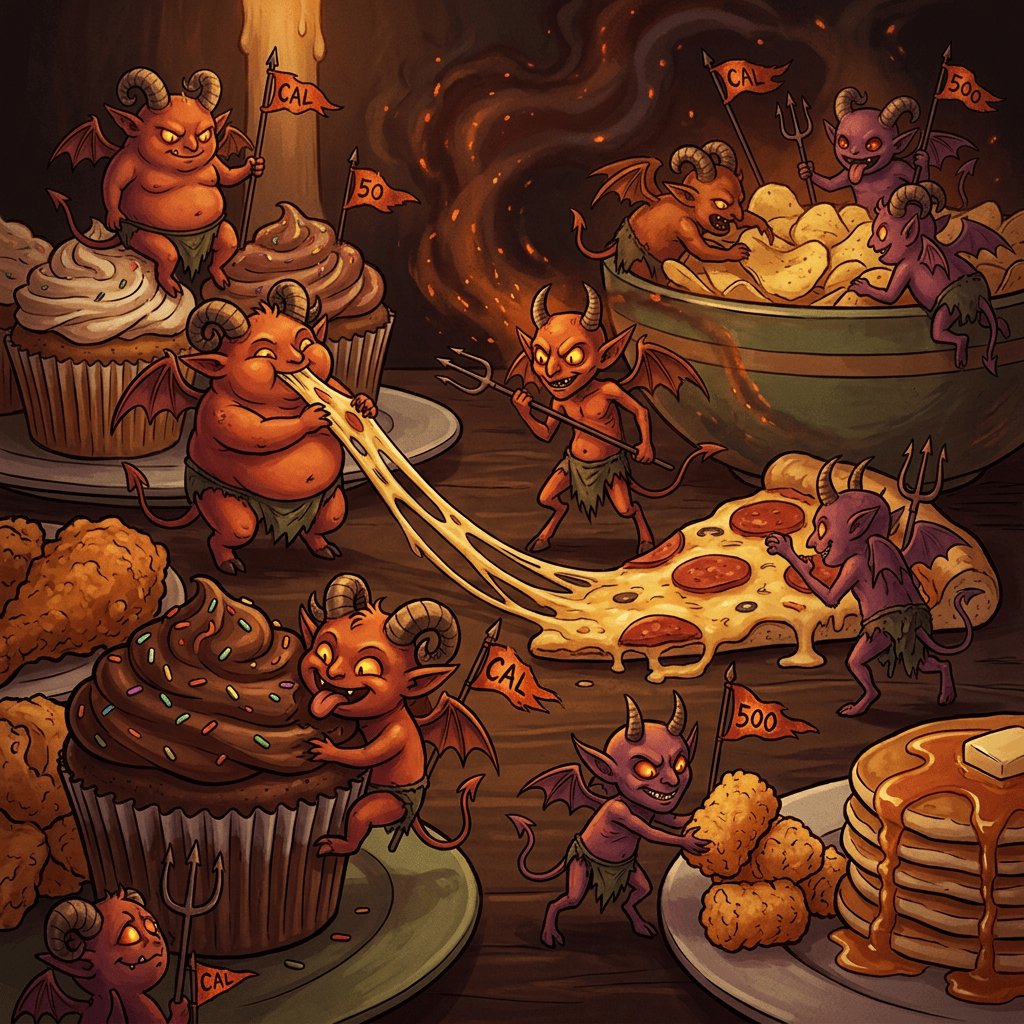
A funny explanation of what calories actually are
Let’s be honest.
Calories have a terrible reputation.
People talk about them the way medieval villagers talked about dragons.
“Beware the calories in that cheesecake.”
“I was good all week until those calories attacked me.”
“Those vacation calories found me immediately.”
Meanwhile, calories are sitting quietly in the corner wondering:
“Why is everyone acting like we’re the villains?”
The truth is, calories aren’t tiny demons hiding in your snacks waiting to sabotage your jeans. They’re not evil. They’re not toxic. They’re not out to ruin your life.
They’re simply a measurement of energy.
That’s it.
Blog over.
Just kidding.
Let’s dive into what calories actually are and why they’ve become the most misunderstood little numbers in nutrition.
What Is a Calorie?
A calorie is a unit of energy.
Think of it like inches measure length and gallons measure volume.
Calories measure energy.
Your body uses that energy too:
- Breathe
- Think
- Walk
- Exercise
- Digest food
- Pump blood
- Blink
- Keep your organs functioning
Even while you’re binge-watching your favorite show and haven’t moved from the couch in three hours, your body is burning calories.
Congratulations.
You’ve been multitasking this whole time.
Your Body Is Like a Very Busy Energy Company
Imagine your body as a city.
The lights need power.
The roads need maintenance.
The water system needs to run.
The emergency services need staffing.
All of that requires energy.
Your body is no different.
Calories are simply the fuel that helps keep everything operational.
Without calories, your body literally couldn’t do its job.
So, when someone says they want to eliminate calories from their diet, that’s a bit like saying they’d like their car to function without gasoline, electricity, or charging.
The enthusiasm is admirable.
Physics are problematic.
Why Do Some Foods Have More Calories Than Others?
Not all foods contain the same amount of energy.
Here’s a simplified breakdown:
Carbohydrates
- 4 calories per gram
Protein
- 4 calories per gram
Fat
- 9 calories per gram
Alcohol
- 7 calories per gram
Notice anything interesting?
Fat contains more than twice as many calories per gram as carbohydrates or protein.
That’s not because fat is evil.
It’s because fat is an efficient source of stored energy.
Nature designed it that way long before social media influencers arrived to argue about it.
The Great Almond vs. Gummy Bear Mystery
Imagine two snacks:
A handful of almonds.
A handful of gummy bears.
They may contain a similar number of calories.
Yet they aren’t identical nutritionally.
Why?
Because calories tell us how much energy a food contains, but they don’t tell us everything about the food.
Foods also differ in:
- Protein
- Fiber
- Vitamins
- Minerals
- Healthy fats
- How filling they are
That’s why nutrition isn’t only about calories.
It’s about the overall package.
Think of calories as the amount of money in a wallet.
They tell you how much is there, but not whether you spent it on groceries, concert tickets, or a life-sized inflatable dinosaur.
Context matters.
So Why Does Weight Change?
Here’s where calories get blamed for everything.
Body weight is influenced by many factors:
- Genetics
- Physical activity
- Sleep
- Stress
- Hormones
- Medical conditions
- Nutrition patterns
- Overall energy balance
Calories play a role because they represent energy coming in through food and drinks.
But they’re only one piece of a much larger picture.
Human bodies are far more complex than a simple calculator.
If weight management were as easy as basic math, nobody would have ever stood in front of an open refrigerator hoping answers would magically appear.
The Myth of “Negative-Calorie Foods”
Every few years, someone claims certain foods burn more calories to digest than they contain.
Usually, celery gets dragged into this conversation.
Poor celery.
Research does not support the idea that any food creates a meaningful calorie deficit simply by eating it.
Your body does use energy to digest food, a process known as the thermic effect of food.
However, you’re not going to eat enough celery to create some kind of nutritional loophole that allows unlimited cheesecake.
If that worked, nutritionists would all be carrying celery sticks like magic wands.
Not All Calories Affect Hunger the Same Way
This is where things get interesting.
A 300-calorie candy snack and a 300-calorie protein-rich meal may affect hunger very differently.
Foods containing:
- Protein
- Fiber
- Healthy fats
often help people feel full longer than highly processed foods that digest quickly.
That’s why many people can eat six cookies and still feel hungry.
Yet a balanced meal can keep them satisfied for hours.
Your stomach has opinions.
And sometimes those opinions are surprisingly strong.
Stop Trying to “Earn” Your Food
One of the strangest things we do is assign moral value to calories.
People say:
- “I was bad.”
- “I cheated.”
- “I earned dessert.”
- “I need to work this off.”
But calories don’t carry moral significance.
They’re not good.
They’re not bad.
They’re energy.
A slice of birthday cake isn’t a character flaw.
A salad isn’t a personality trait.
Food choices can support your goals in different ways, but assigning guilt to every calorie often creates more stress than success.
What Actually Matters?
Rather than obsessing over every calorie, focus on the bigger picture:
- Eating balanced meals
- Including fruits and vegetables
- Getting enough protein
- Staying active
- Prioritizing sleep
- Managing stress
- Enjoying treats without guilt
- Building sustainable habits
Because long-term health is built on patterns, not perfection.
Nobody’s wellness journey has ever been destroyed by a single cupcake.
Unless it was dropped directly onto their laptop.
Final Thoughts
Calories are not tiny demons.
They are not lurking in your pantry plotting your downfall.
They’re simply units of energy that help your body function.
The real goal isn’t to fear calories.
It’s to understand them.
When you stop seeing calories as enemies and start seeing them as fuel, nutrition becomes a lot less confusing and a lot more sustainable.
So the next time someone warns you about calories as if they’re mythical creatures hiding in your food, remember:
Calories are just energy.
The real troublemakers are usually stress, sleep deprivation, and that voice that says,
“One cookie won’t hurt.”
Followed immediately by,
“Since we’re here, let’s take six.”