No certifications. No scheduling skills. Unlimited energy. Questionable coaching methods.
If you have a toddler, you may have noticed that your fitness routine has changed.
Gone are the days of peacefully heading to the gym, following a carefully planned workout, and drinking your water without someone stealing your bottle.
Now you have a personal trainer who weighs approximately 30 pounds, has the energy of a caffeinated squirrel, and believes that every household object is an obstacle course.
Welcome to toddler-assisted fitness.
Your trainer doesn’t believe in warm-ups, rest periods, or reasonable expectations. They believe in running in circles, randomly yelling “GO!”, and demanding that you pick up something they just threw across the room.
And honestly? You might be getting a pretty good workout.
1. The Toddler Squat Challenge
Trainer’s instructions: Pick up the toy. Put it down. Pick up another toy. Put it down. Repeat approximately 47 times.
You might think you’re cleaning the living room, but congratulations! You’re performing functional strength training.
Squats work several major muscle groups, including your quadriceps, glutes, and hamstrings.
Your toddler will help increase the difficulty by moving the toys every time you bend down.
Pro tip: Bend at your hips and knees, keep the object close, and avoid twisting while lifting. Your lower back did not sign up for this program.
2. The Never-Ending Sprint
Trainer’s instructions: Chase me!
You haven’t run this fast since someone yelled that the ice cream truck was leaving.
Toddlers love short bursts of movement. One minute they’re running down the hallway, the next they’re hiding behind the couch, and suddenly you’re participating in an Olympic-level pursuit of someone wearing one sock.
Short bursts of activity can contribute to your overall physical activity.
Just remember: the goal is movement, not actually catching your toddler before they reach the dog bowl.
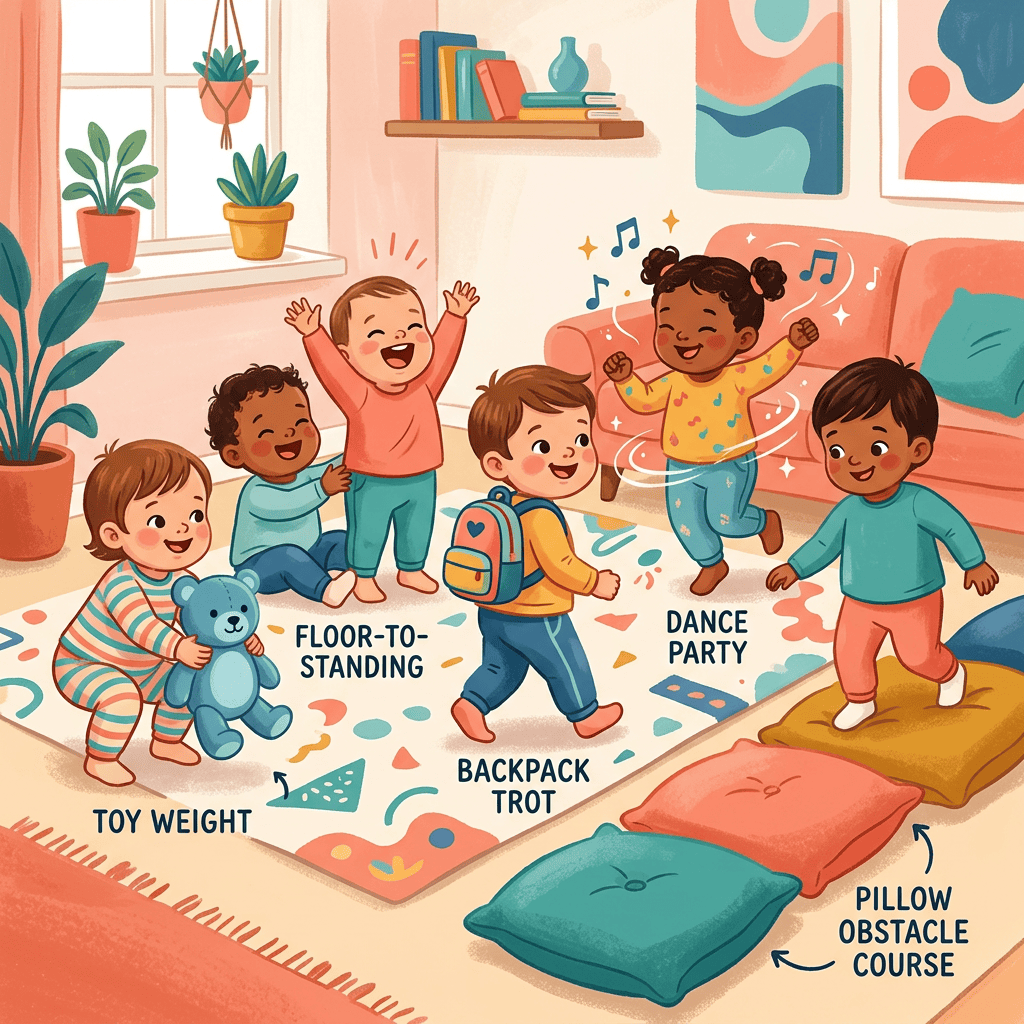
3. The Floor-to-Standing Workout
Trainer’s instructions: Sit with me. Now stand up. Actually, sit back down. I need a snack.
If you want to improve your leg strength and balance, congratulations. You have enrolled in the toddler floor workout.
You will:
- Sit on the floor.
- Stand up.
- Sit back down.
- Get interrupted.
- Stand up again.
- Forget why you stood up.
Repeat throughout the day.
It’s basically a full-body workout with a very unpredictable playlist.
4. The Weighted Carry
Trainer’s instructions: Carry me. No, not like that. UP!
Your toddler has discovered that being carried is a luxury service, and you are the employee.
Carrying a child can challenge your arms, shoulders, and core, depending on the child’s size and how you carry them.
Unfortunately, your trainer may demand to be carried while holding three stuffed animals, a snack cup, and a toy truck.
Safety note: Use good posture, keep your child secure, and don’t carry more than you can comfortably manage.
5. The Dance Party Cardio Session
Trainer’s instructions: AGAIN! AGAIN! AGAIN!
You thought one dance party was enough.
Your toddler disagrees.
Put on some music and dance around the living room. Dancing can raise your heart rate, improve coordination, and contribute to cardiovascular fitness.
Bonus points if your toddler insists on the same song 19 times.
By the end, you’ll know every word, every dance move, and exactly how much stamina you have left.
6. The Obstacle Course Nobody Asked For
Trainer’s instructions: Don’t step on the pillows. Jump over the blanket. Crawl under the table!
Your living room is now a fitness facility.
Pillows become stepping stones. Blankets become tunnels. Couch cushions become mountains.
This kind of active play encourages children to practice balance, coordination, and movement skills.
Just make sure the course is age-appropriate, stable, and free of sharp edges or tripping hazards. Your toddler may believe they’re invincible. You should know better.
7. The Personal Trainer’s Rest Period
Trainer’s instructions: STOP. I need a snack.
Finally! A break.
Except your toddler has decided that you must open the snack, peel the banana, find the missing cup, and locate a specific stuffed animal that apparently went missing in 2023.
Your rest period is over.
Fitness tip: Recovery matters. Adults need rest between challenging workouts, and sleep is important for recovery, too. Don’t feel guilty about taking an actual break.
Your toddler will probably disagree, but that’s between you and management.
The Science Behind the Chaos
As ridiculous as toddler-assisted workouts sound, there are some real benefits to moving more throughout the day.
For adults, the CDC recommends at least:
- 150 minutes of moderate-intensity aerobic activity each week, or 75 minutes of vigorous activity.
- Muscle-strengthening activities at least two days per week.
You don’t have to complete all your activity in one session. Shorter periods of movement can add up.
For children ages 3–5, the CDC recommends being physically active throughout the day.
Active play is an important way for young children to develop movement skills, coordination, and healthy habits.
So while your toddler’s workout program may be poorly organized, the movement itself can be beneficial for both of you.
How to Survive Your Toddler’s Fitness Program
A few ground rules:
- Keep expectations realistic. A 10-minute workout is better than waiting for the perfect hour that never comes.
- Make movement fun. Dance, walk, play, stretch, and enjoy being active together.
- Don’t forget your own workout. Toddler play is wonderful, but it won’t necessarily replace structured strength training or aerobic exercise.
- Stay hydrated. Your toddler will probably try to drink from your bottle. Bring two.
- Know when to stop. Pain, dizziness, and unusual shortness of breath are not signs of a successful workout.
- Take advantage of naps. Sometimes the best workout happens when your trainer is off duty.
Final Thoughts: You’re Not Behind. You’re Just Training Differently.
Exercise doesn’t always look like matching workout clothes, perfectly planned routines, and an hour at the gym.
Sometimes it looks like chasing a tiny human through the kitchen, carrying a toddler who suddenly forgot how legs work, and dancing to the same song until you question every life decision.
And that’s okay.
Find ways to move that fit your actual life. Start small. Celebrate consistency. Give yourself credit.
You don’t need a perfect workout routine to make progress.
You just need to keep moving.
And maybe, just maybe, negotiate a better contract with your personal trainer.
Because honestly, anyone who charges you in crackers, refuses to follow instructions, and schedules meetings at 5 a.m. needs to be fired.
Disclaimer: Toddler-assisted exercise is not a substitute for a structured fitness program. Keep children supervised, use age-appropriate activities, and adapt exercise to your own fitness level.