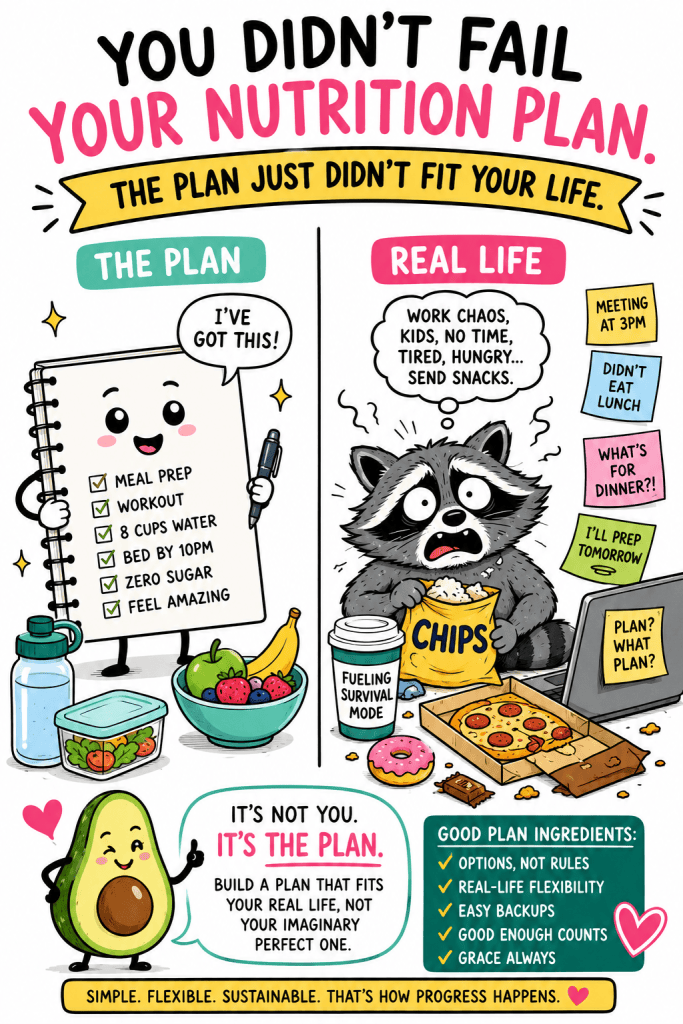
Let’s clear something up right away: You didn’t fail your nutrition plan. The plan just didn’t fit your life.
I know, I know — it feels like a technicality. But it’s actually the difference between staying stuck in frustration and finally moving forward without constantly starting over.
Because if every time a plan doesn’t work, you assume you’re the problem… you’re going to keep trying harder at something that was never designed to work in the first place.
The “Perfect Plan” That Falls Apart by Tuesday
You know the one.
- You start on Monday
- You have the groceries
- You’re motivated, focused, ready to go
By Tuesday afternoon:
- Work gets chaotic
- You skip a meal
- You grab something quickly
- The plan starts slipping
By Thursday:
- You’re improvising
- Feeling guilty
- Thinking, “I already messed up…”
By the weekend? The plan is officially abandoned and you’re wondering what’s wrong with you.
Spoiler: nothing is wrong with you. That plan didn’t fail because you lacked discipline. It failed because it required a version of your life that doesn’t exist on a regular Wednesday.
Most Nutrition Plans Are Built for Ideal Conditions
A lot of plans assume you:
- Have consistent energy
- Have time to prep and cook
- Eat at predictable times
- Aren’t dealing with stress, fatigue, or interruptions
In other words, they’re built for a calm, controlled, perfectly scheduled life.
Not:
- A job that throws curveballs
- Family obligations
- Mental fatigue
- Days where making cereal feels like a win
So when the plan breaks, it’s not because you’re “bad at sticking to things.” It’s because the plan expects you to operate like a robot.
And unless you are a robot (in which case, welcome, fellow machine), that’s not happening.
The Real Problem: Rigidity
Most plans rely on rules like:
- “Eat these exact meals.”
- “Avoid these foods completely.”
- “Follow this schedule perfectly.”
That works… until life happens. And life always happens.
The moment something doesn’t go exactly as planned, there’s no flexibility built in. So instead of adjusting, you feel like you’ve failed.
But here’s the thing: A plan that only works under perfect conditions isn’t a good plan. It’s a fragile one.
The Shift That Changes Everything
Stop trying to fit your life into a nutrition plan. Start building a plan that fits into your life.
Your reality includes:
- Busy days
- Low‑energy moments
- Last‑minute changes
- Real cravings and real hunger
If your plan doesn’t account for those things, it’s already set up to break.
What a Plan That Actually Fits Looks Like
Options, Not Rules
Instead of: “Eat this exact lunch.” Try: “Choose one of these 3–5 easy options.”
Now you have:
- Flexibility
- Less decision fatigue
- A backup when life shifts
“Good Enough” Meals Count
Not every meal needs to be:
- Balanced
- Beautiful
- Instagram‑worthy
Some days it’s:
- A wrap
- A bowl
- A mix of whatever works
Still counts. Progress is built on repeatable choices, not perfect ones.
Built‑In Backup Plans
What happens when:
- You’re too tired to cook
- You forgot to prep
- Your day goes sideways
If your plan doesn’t answer that, it’s incomplete.
Real‑life nutrition includes:
- Quick grab‑and‑go options
- Simple fallback meals
- Permission to pivot
Flexibility Around Energy, Not Just Time
You don’t just run out of time — you run out of energy.
Some days you can cook. Some days you absolutely cannot.
A workable plan includes:
- Low‑effort options
- Minimal‑prep meals
- Days where “easy” is the goal, not gourmet
The Guilt Trap (Let’s Talk About It)
When a plan doesn’t work, it’s easy to go straight to:
- “I lack willpower.”
- “I need to be more disciplined.”
- “I always do this.”
But that creates a cycle:
Start strict → Slip (because of life) → Feel like you failed → Quit → Start over harder next time
That cycle isn’t motivation — it’s burnout in disguise.
And it keeps you focused on fixing yourself instead of fixing the system.
The Real Win: Sustainability Over Intensity
A plan that fits your life might not feel exciting. It might look like:
- Repeating meals
- Keeping things simple
- Leaving room for imperfection
But here’s what it does offer:
- Consistency
- Less stress
- Fewer restarts
And over time? That’s what actually creates change.
Final Thought: You’re Not the Problem — Your Plan Needs an Upgrade
If you’ve ever felt like you just “can’t stick to anything,” take a step back and ask:
Was this plan built for my real life — or for an ideal version of me?
Because you don’t need:
- More restrictions
- More pressure
- More perfect days
You need a plan that works on your busiest, messiest, lowest‑energy days — not just your best ones.
So no, you didn’t fail your nutrition plan. You just outgrew one that didn’t fit.
And that? That’s actually progress.
 Whatnot Healthy Lifestyle & Coaching