You eat the salad. He eats the burger. You both start “watching what you eat.” Three weeks later, he’s down 8 pounds. You’re down 2. And suddenly you’re standing on the scale thinking:
“ARE YOU KIDDING ME?! I HAVE BEEN EATING VEGETABLES!”
If this sounds familiar, you’re not imagining the phenomenon. Research does show that, on average, men tend to lose weight more quickly than women during the early stages of weight loss.
But before we accuse men of having a secret metabolism powered by pizza, wings, beer, and testosterone, there’s actually some science behind it.
First: Men Usually Start With More Muscle
One of the biggest reasons is body composition.
Men generally have more lean muscle mass than women, while women generally have a higher percentage of body fat. Muscle tissue requires more energy to maintain than fat tissue, which means a person with more muscle generally burns more calories at rest.
In other words, two people can be the exact same height and even weigh the same, but their bodies may have very different calorie requirements.
Therefore, when a man and woman follow the same calorie-restricted plan, the man may start with a larger calorie deficit simply because his body requires more energy to keep running.
Translation: He isn’t necessarily “trying harder.”
It is just his metabolic starting line may simply be different.
The Bigger You Are, the More Calories You Usually Burn
Here’s another annoying-but-important detail.
Men are, on average, larger and have more muscle mass than women. That means they typically burn more calories throughout the day. Imagine two cars driving the same distance (Think Fiat/Mini Cooper vs. Mazda).
One has a tiny fuel-efficient engine.
The other has a giant engine. They’re both going 50 miles per hour, but the big engine is probably burning through more fuel.
That’s a little like comparing energy needs between people.
If a man normally needs 2,500 calories a day and a woman needs 1,800, cutting 500 calories from each diet doesn’t create the same percentage reduction.
The numbers matter.
That’s why comparing someone’s “I lost 10 pounds!” to your “I lost 5 pounds…” without knowing starting weight, calorie needs, body composition and time frame can be incredibly misleading.
And Then There’s the Fat Distribution Situation
Men and women also tend to store fat differently.
Men are more likely to carry a greater proportion of their excess fat around the abdomen and as visceral fat.
Women are more likely to carry more subcutaneous fat, particularly around the hips and thighs.
And here’s where things get interesting: research has found that for a given amount of weight loss, men may lose more visceral fat and show a larger reduction in waist circumference, while women may lose more fat from certain subcutaneous areas.
The scale isn’t telling the whole story
Two people could lose the same amount of weight while experiencing different changes in where that weight came from.
Women’s Bodies Are Really Good at Saving Energy
Here’s where biology gets particularly interesting. Research suggests that women have physiological mechanisms that are better adapted to conserving energy stores during periods of calorie shortage.
From an evolutionary perspective, this makes sense.
- The human body doesn’t know you’re trying to fit into your favorite jeans.
- It doesn’t know you’ve downloaded a calorie-tracking app.
- It doesn’t care that your vacation is six weeks away.
Your body simply sees a reduction in available energy and says:
“Hmm. Food supplies appear to be decreasing. Everyone remain calm. WE ARE SAVING THE FAT.”
Women’s metabolism and fat storage patterns are influenced by sex hormones and other biological differences that affect how the body stores and uses energy.
That doesn’t mean women are “broken.”
Quite the opposite.
The female body has some remarkably efficient systems for protecting energy stores.
Unfortunately, those systems aren’t always particularly helpful when your goal is to make the number on the bathroom scale smaller.
But Here’s the Part We REALLY Need to Talk About
Faster weight loss doesn’t necessarily mean better weight loss.
A study examining men and women during weight loss found that men lost more weight during the early stages, but the difference became smaller over time. Researchers also found differences in the amount and type of tissue lost.
In other words, the dramatic “HE LOST 10 POUNDS AND I LOST 4!” comparison doesn’t necessarily predict where either person will end up months later.
The U.S. Office on Women’s Health makes a similar point: men often lose weight faster initially, but weight loss tends to even out over time.
Ladies, Save the Pitchforks for Later.
If your husband, boyfriend, brother or male coworker loses 7 pounds in the first month while you’re celebrating your 3-pound loss, it doesn’t mean you’re doing something wrong.
It doesn’t mean your metabolism is “broken.”
It doesn’t mean you need to eat less.
And it DEFINITELY doesn’t mean you should start surviving exclusively on celery because John from accounting lost 12 pounds eating steak.
Your body is different.
Your caloric needs are different.
Your muscle mass is different.
Your hormones are different.
Your fat distribution is different.
And your weight-loss journey doesn’t have to look like anyone else’s.
The Scale Is Not a Competition
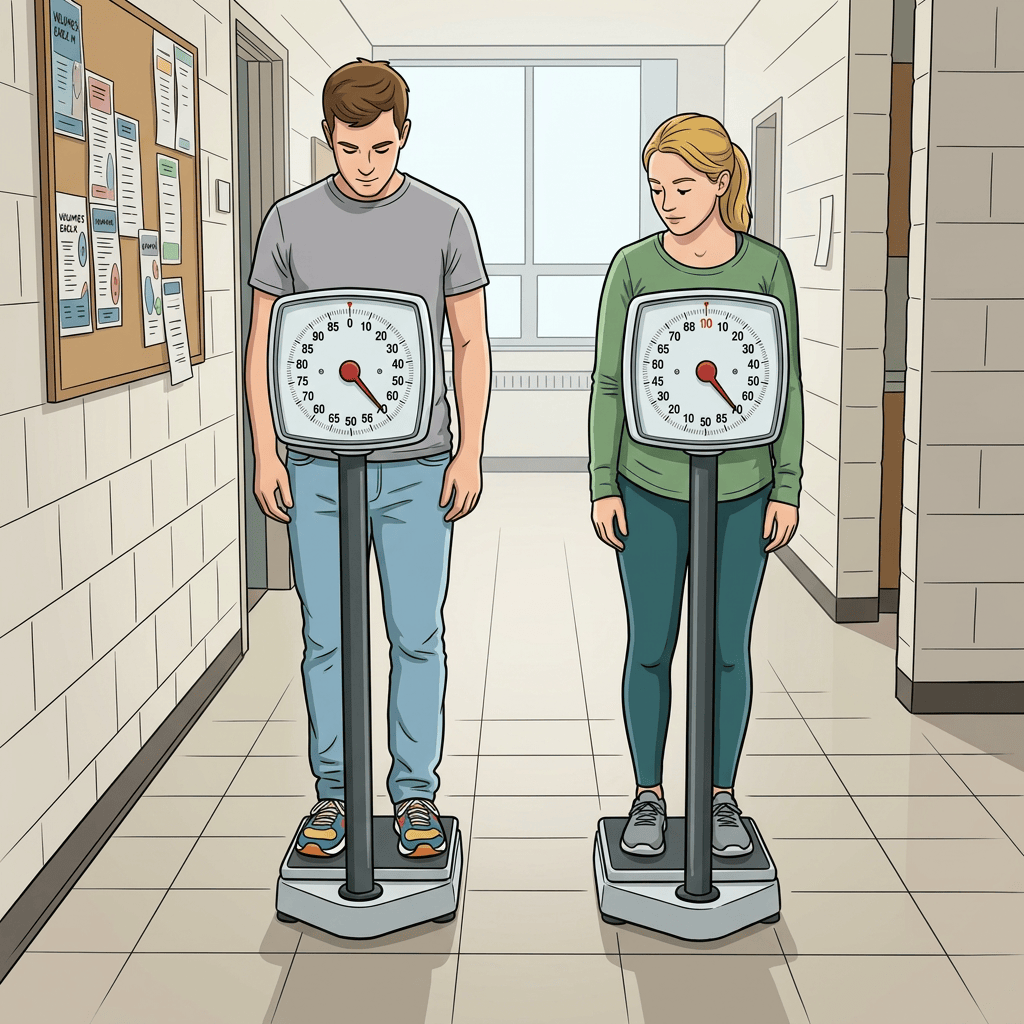
This might be the most important part.
Weight loss is not a race between Team Testosterone and Team Estrogen.
The goal isn’t to beat your husband to the next five-pound milestone.
The goal is to improve your health in a way you can actually maintain.
And if you lose weight more slowly than the man standing next to you?
Congratulations. You are still losing weight.
Because your body isn’t failing.
It’s simply playing by its own set of biological rules.
And honestly?
Considering how many things women already have to deal with, maybe we can let the guys have their slightly faster first few pounds.
The Bottom Line
Yes, men often lose weight faster than women—especially early on.
The reasons include differences in muscle mass, body size, energy expenditure, fat distribution and hormonal/metabolic physiology.
But faster doesn’t automatically mean healthier, better or more sustainable.
Don’t compare your chapter one to someone else’s chapter five—or your metabolism to someone else’s entirely different biology.

