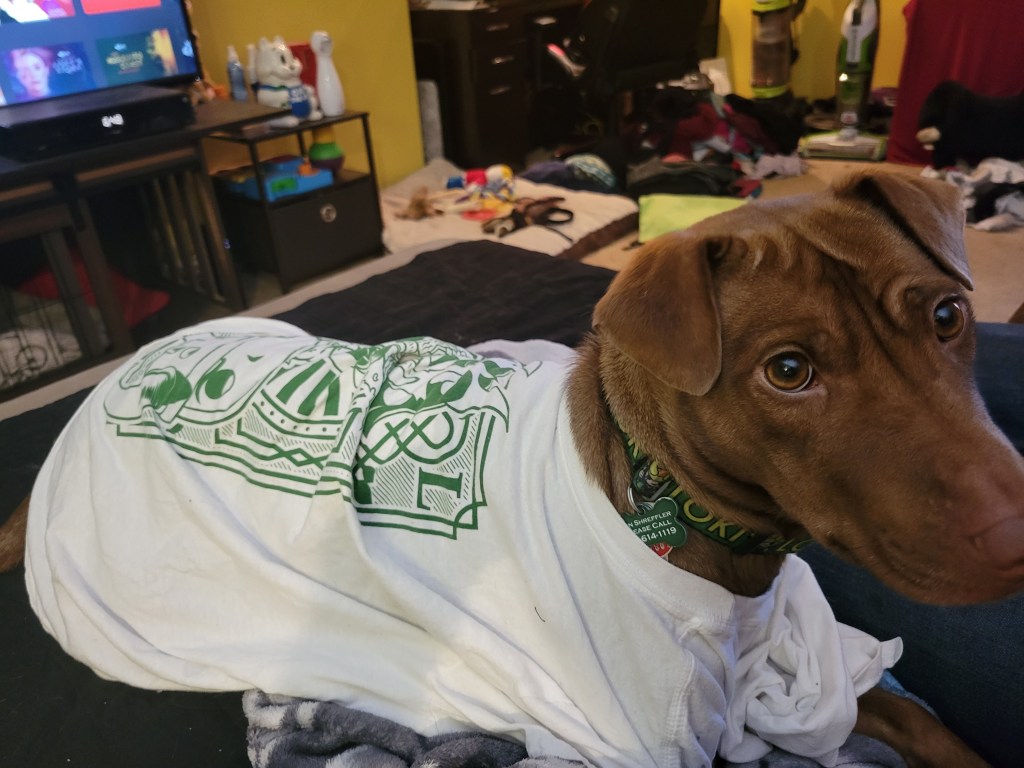
This week’s topic, yes, delayed, but it came with a lot of thought and consideration — I wanted to do this topic right and give it the right amount of time and justice. I have seen a few posts about running with dogs on coaching boards and I, of course run with Accountability Coach Loki. I do not take this topic lightly as I love running with dogs, it makes me feel safer as a female runner to have that companion to help keep me safe, it is also a good outlet for the dog too, but I have also seen runners get injured while running with dogs.
To begin there are a few things you should factor into running with your dog, breed, health, and age. Let start with breed. Not all dogs are suitable for being a running companions due to pre-existing complications, like breathing issues. Then there are other things to factor in, where do you live, surface conditions, and the distances you are trying to run. According to the AKC the following breeds are some of the best running companions based on their endurance, obedience, strength, athleticism and intelligence: Weimaraner, Dalmatian, Vizsla, German Shorthaired Pointer, Rhodesian Ridgeback, English Springer Spaniel, Doberman Pinscher, American Foxhound, Saluki, and Belgian Malinois.
Next looking at dogs health and age, for instance, the breed and health can play hand in hand, running with a Pug would not be ideal due to pre-existing breathing conditions. However, for years I ran with my Sheltie, however she is now 13 years old with arthritis and seasonal allergies. Plus she basically told me she is done being my running partner by hiding every time I try to get her harness on her. It’s not often I have seen dogs tell me when they don’t want to run anymore. Loki who is about half the age of the sheltie, loves running and finds it as her job, her sense of duty. However, Loki does have one thing working against her in the future, she had surgery on one of her legs when she was a puppy prior to her adoption. We know that in the future she may not run, but it makes her happy now and helps contain her anxiety so we will continue with running with her while we still can. Moral of this story is just listen to your dog with their health and age.
Now, let’s take a look at HOW to run with your dog, don’t push your dog – they are supposed to be your companion, it is supposed to be fun for you and them, don’t go and try to break records. Make sure they are good at walking on the leash and listening to cues, you need to learn to walk with your dog before you run, if they cannot walk on a leash and listen then, you try running, you could be pulled down and injured. Start off slowly, dogs like humans need to build a tolerance for speed and distance, give a natural progression like you would for yourself, don’t push them too hard. Next, make sure you have the right gear, you may go through and try several things, whether it is a hip leash, long leash, harness, martingale collar, and so on… Different breeds and personality of dogs and owners will require different things. For instance, the Sheltie, I previously mentioned, knows how to slip a regular collar, however she is perfect in a harness and prior to her self-appointed retirement from running, she was trained and great on a hip leash. Where Loki, it took some time and a few collars, we found she worked better on a harness for running and that we either needed to use a regular leash or in certain areas where applicable (areas where she can have more fun) a long leash. You won’t know what you need for them until you try it.

Finally, we can now explore tips to train and run safely with your four-legged companion. We already know the breed, age, walk before you run, and build up endurance are all great tips to start. Next, try working on cues with your dog, for instance, when I want Loki to speed up on the run, I use the phrase “let’s go”, when I need her to run closer to me “heel”, when I need her to go up on something “up up”, each dog will respond to different cues, either way you need to continue to repeat and work with your dog on it. By no means use my cues, but they are ones that Loki seems to like and will work with.
Some final tips from the AKC to running with your dog
- Warm up and cool down as you would, dogs need that just as much as you
- Keep an eye on the weather, certain breeds can’t handle heat and/or cold very well
- Give them breaks, they may need to go to the bathroom or just want to sniff around, be patient with them.
- Don’t let them go off leash, unless it’s in a safe, legal area and your dog has EXCELLCENT recall. If they have mediocre recall, this is where I suggest a long leash, it gives them a little more freedom and you can still work on recall.
- Watch for signs that they had enough, they will run to please their need to have duty, but they will do it to please you too. Look for excessive panting or lagging behind.
These are things to think about when running with your four-legged companion. However, even the best companion and training can lead to injury, due to the dog’s natural excitement instinct or the need to protect. I have seen this firsthand recently, however it does not change my mind that running with Loki is something I thoroughly enjoy, it helps her and myself both mentally, physically, and it makes me feel safe. Be careful and use your best judgement when choosing your four-legged running companion and be safe when running protect them and yourself.
 Whatnot Healthy Lifestyle & Coaching